

Many physicians naturally gravitate towards real estate as way to create long-term wealth, attracted by its tangibility and perceived safety. Nevertheless, direct property ownership often brings unanticipated headaches—liquidity constraints, ongoing maintenance expenses, tenant issues, and regional volatility. Real Estate Investment Trusts (REITs) are an interesting alternative to direct property ownership, combining the wealth-building potential of real estate with the liquidity, ease of access, and diversification offered by public markets. For doctors, REITs present a compelling way to achieve real estate exposure without the complexity or capital intensity of direct ownership.
Understanding REITs: Real Estate Ownership, Simplified
At their core, REITs are companies that own, operate, or finance income-producing real estate assets, such as apartment complexes, office buildings, warehouses or shopping malls. REITs pool capital from different individual investors to acquire properties as a single entity, properties that would’ve otherwise been difficult for those investors to own directly. Many REITs are traded publicly on stock exchanges, and in those cases REIT shares are bought and sold like stocks, offering liquidity unavailable to direct property investors.
Crucially, REITs in the US are legally mandated to distribute at least 90% of taxable income as dividends, resulting in consistent income streams.
The Compelling Case for Doctors: Liquidity, Diversification, and Income
Liquidity
Liquidity stands out as a critical advantage. Direct property sales can require months to complete and carry significant transaction costs ranging from 5% to 6%. REITs, conversely, offer immediate liquidity and low transaction costs, allowing physicians to adapt to personal or market changes without locking capital into a single illiquid property.
Diversification
Diversification further enhances REITs’ appeal. Unlike direct property ownership, which exposes investors to localized risks like market downturns, natural disasters, tenant issues, weather events or regulatory shifts, REITs spread investments across numerous properties and regions. This significantly reduces volatility and provides greater stability.
Dividends
REITs’ dividend income also represents a crucial advantage. From 2020 to 2025, publicly traded U.S. FTSE Nareit All REITs delivered an average annual dividend yield of approximately 3.99%, based on annual yields from 2020 to 2025.
Understanding the Risks
While offering compelling advantages, REITs also carry some risks physicians must consider. Most significantly, REITs tend to be sensitive to interest rate fluctuations. Rising rates increase borrowing costs, often negatively impacting profitability and share prices. A recent illustration occurred in 2022 when aggressive interest rate hikes saw the FTSE Nareit All REITs Index decline 25.1%, though it rebounded 11.4% in 2023 and further recovered in 20241.
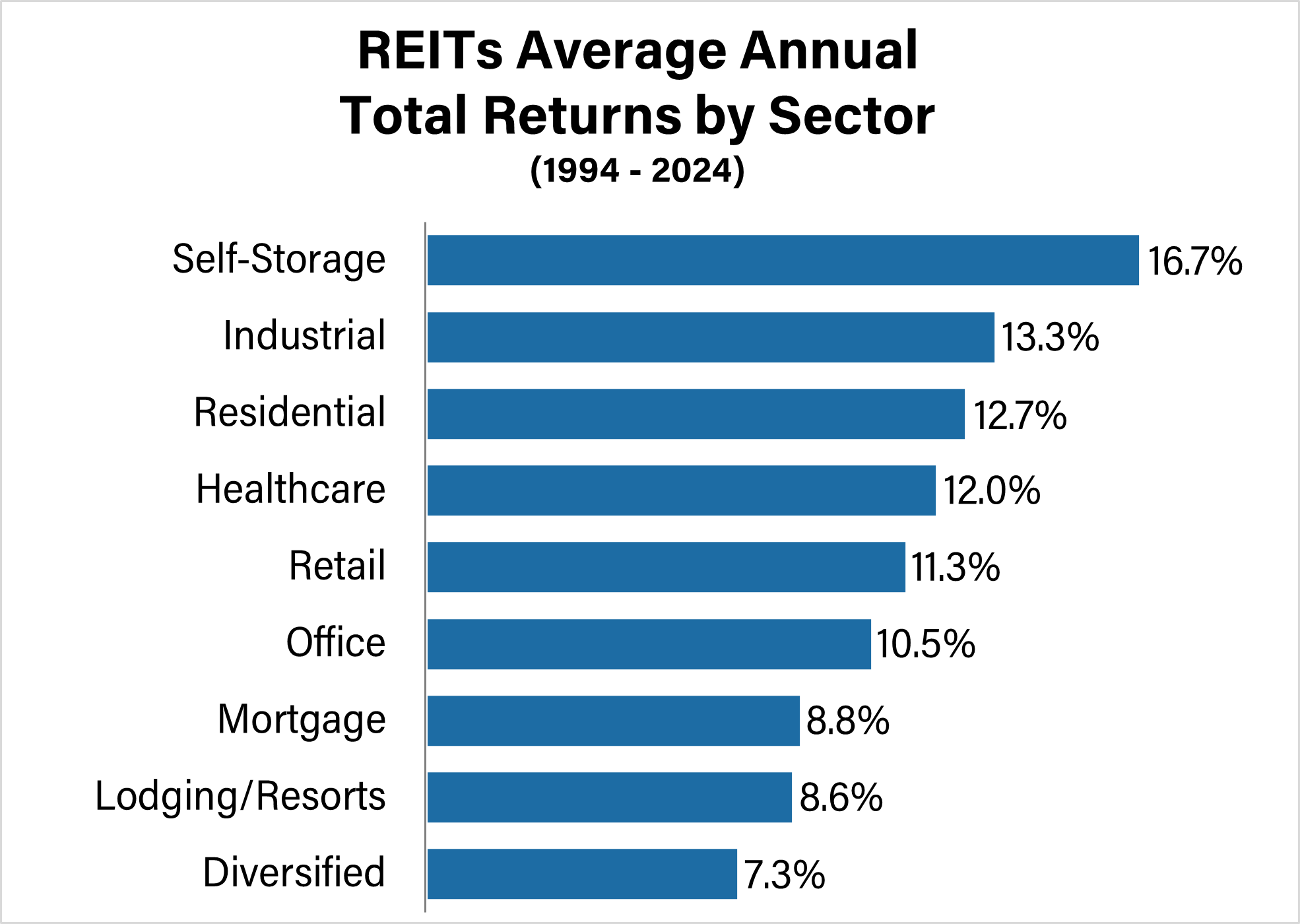
Unlike physical real estate—whose illiquidity paradoxically may shield it temporarily from at least the perception of rapid valuation changes—REIT values fluctuate regularly, which can test investor discipline during turbulent periods. Sector-specific risks also require attention. Commercial REITs, particularly in retail or office sectors, face headwinds from shifting consumer behaviors, remote work adoption, and e-commerce. On the other hand, residential REITs benefit from consistent housing shortages and steady rental demand, underscoring the importance of strategic sectoral diversification.
A Smart Path to Real Estate Investing for Physicians
REITs represent a sophisticated and strategic way for physicians to access real estate’s wealth-building potential without the burdensome constraints of direct property ownership. While offering liquidity, diversification, consistent income, and ease of management, REITs do carry risks—particularly higher sensitivity to interest rates—that require careful consideration.
At Handal Dunaway, we specialize in helping physicians construct thoughtful investment portfolios that align seamlessly with their professional demands, lifestyle priorities, and long-term financial objectives. Through careful selection, intelligent diversification, and ongoing strategic guidance, we work on building wealth with clarity and purpose.
- NAREIT Industry Fact Sheet Data as of June 30, 2025 ↩︎