

Private Equity has quietly become one of the most powerful drivers of wealth creation in modern markets. Over the past two decades, it has repeatedly outperformed public equities, rewarding investors who could commit capital for the long haul. For many individual investors, the longer holding periods and lack of liquidity can be a deterrent. But for physicians, who can have more stable earnings and longer careers than other professionals, the asset class is a natural fit.
A Track Record That Outpaces Public Markets
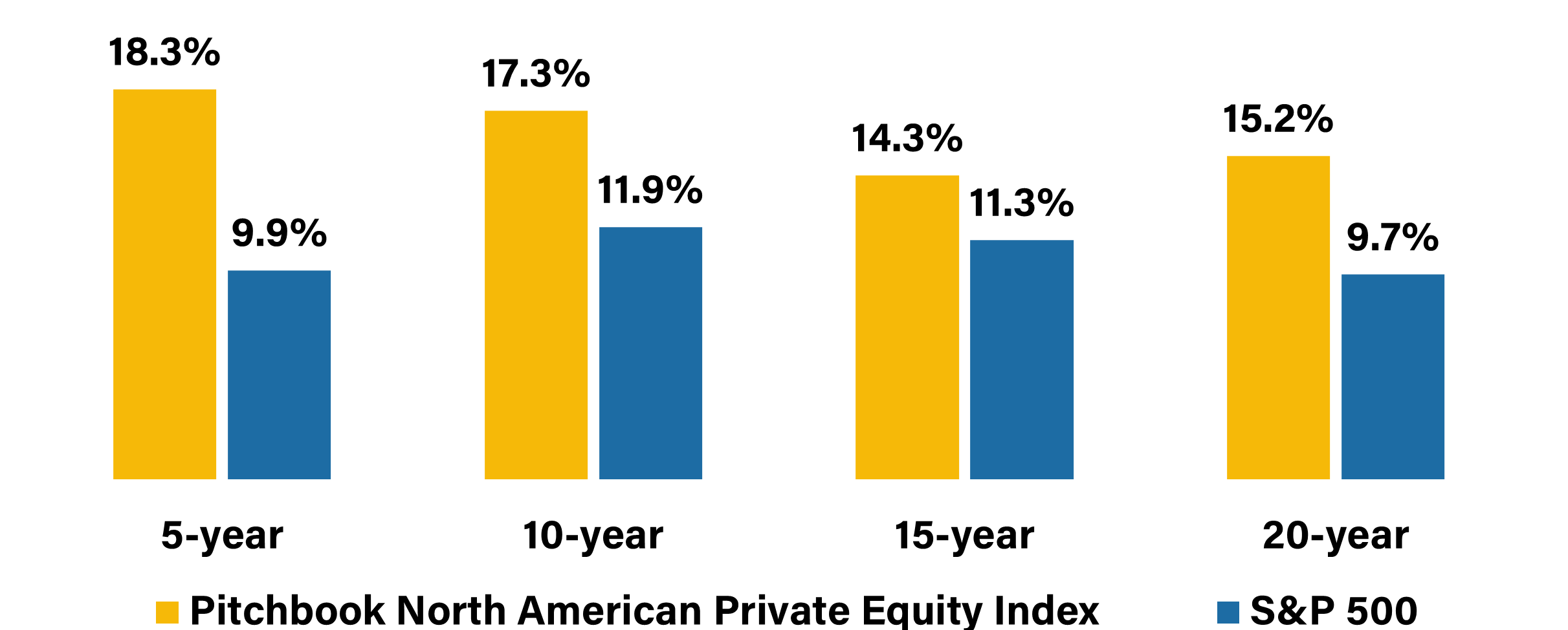
As of December 2023, the PitchBook North American Private Equity Index beat the S&P 500 across every major time horizon—5, 10, 15, and 20 years. Data shows PE funds generating roughly 15% annualized returns (IRR) as of Q3 2024, compared to around 7.8% in the public markets. For doctors with the ability to lock up capital, those extra percentage points translate into meaningful long-term wealth.
Performance snapshot:
- 5 years: 18.3% (PE) vs. 9.9% (S&P 500)
- 10 years: 17.3% vs. 11.9%
- 15 years: 14.3% vs. 11.3%
- 20 years: 15.2% vs. 9.7%
Why Physicians Have a Unique Advantage
The illiquidity of Private Equity—typically a 5–7 year holding period—can be a barrier for investors who need frequent access to cash. For established physicians, though, their more stable incomes means this is often not a major constraint and they can take advantage of the higher returns. Even with a modest allocation (15–20% of a portfolio), doctors can capture PE’s return premium while still maintaining liquidity for opportunities, lifestyle needs, or emergencies.
Broadening Avenues to Invest
Private Equity has matured into a highly diverse ecosystem. While large-scale firms like Blackstone or KKR often command headlines, smaller and more specialized funds have gained traction – particularly in the middle and lower-middle markets, such as Handal Dunaway’s AI Tactical Opportunities Fund. These funds often focus on niche industries or regional opportunities overlooked by mega funds, and they remain more accessible to high-net-worth individuals.
Beyond direct fund commitments, investors can also gain exposure by purchasing shares in publicly listed PE giants such as Carlyle and TPG. While this route resolves the liquidity issue, it also introduces the complexity of investing in diversified asset managers whose performance extends well beyond core Private Equity operations.
Access Remains the Key Challenge
Despite growing demand, entry points into compelling Private Equity funds are still not widely available for individuals outside the ultra-high-net-worth tier. Some firms are increasingly working with investment advisors to open doors, but accessibility remains limited. As awareness rises, the question is not whether physicians should be involved in Private Equity, but whether the industry will expand access to meet this demand.
Handal Dunaway: Tailored Strategies for Physicians
En Handal Dunaway, we know physicians carry unique challenges: grueling work hours, administrative responsibilities, and personal commitments often leave little time for financial management. That’s why our team specializes in designing investment strategies that fit the realities of doctors’ lives—helping them benefit from asset classes like Private Equity without adding another burden.
You dedicate your career to patients. We dedicate ours to ensuring your wealth continues to grow.