

The English Premier League (EPL) continues to be the financial leader of the football world. With a median player salary of $3.5 million per year, it far exceeds the median salary of any other European league, according to Handal Dunaway’s 2025 Premier League Compensation Report™.
While leading teams at top 5 European football leagues, such as Real Madrid or Bayern Munchën, have pay levels competitive with top Premier League teams, the EPL dominates the global rankings of top-paying teams. Nevertheless, stagnation in EPL domestic broadcast fee growth has started to bleed into player compensation levels, threatening the league’s leadership in the coming years.
Global Football Median Compensation by League
2025/2026 Seasons1
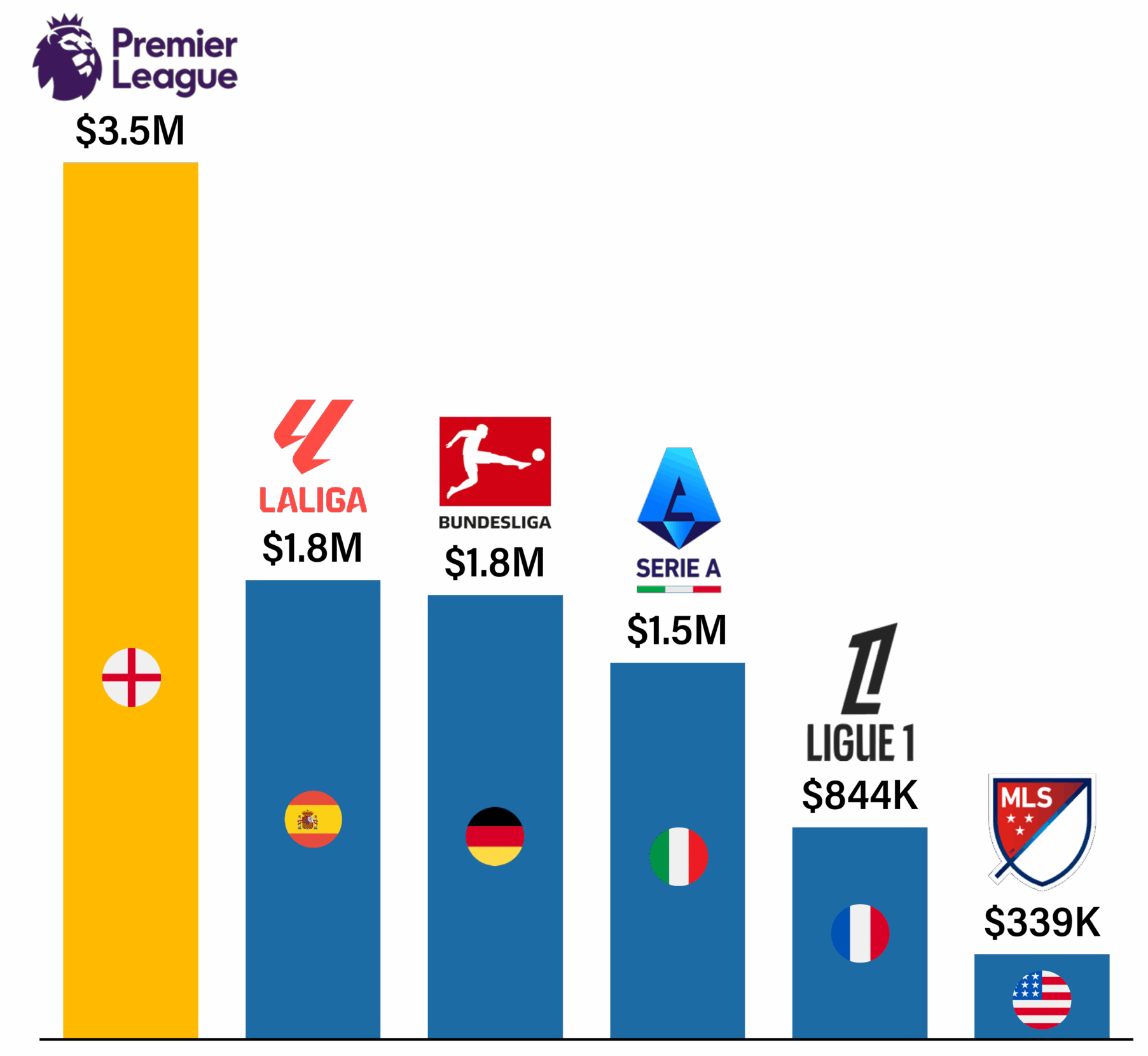
The Global Benchmark
Across Europe, no domestic league rivals the Premier League’s ability to sustain high player compensation across teams big and small. For the 2025/26 season, EPL median salaries are nearly double those of Spain’s La Liga and Germany’s Bundesliga and more than ten times higher than the US’ Major League Soccer. Even Italy’s Serie A, once close in total spending, has fallen well behind.
A key reason behind the higher compensation levels has been the EPL’s historically high ratings and international appeal. The EPL receives ~$2.2 billion annually in domestic broadcasting fees under their current deal through 2029, while international broadcast fees have reportedly outgrown domestic fees in the last few years. Growing international audiences and global commercial deals have cemented its position as the most valuable football league in the world.
Player Comp Levels More Competitive at the Individual Team Level
While traditional European powerhouses in other leagues such as Real Madrid, Bayern Munchën and Barcelona continue to lead at the very top of the continent’s compensation rankings, the Premier League’s strength lies in its breadth. Manchester City, Arsenal, and Manchester United each remain among the top five globally and EPL teams make up 5 of the top 10 paying teams and 8 out of the top 20.
Top 10 European Teams by Median Compensation
2025/2026 Season
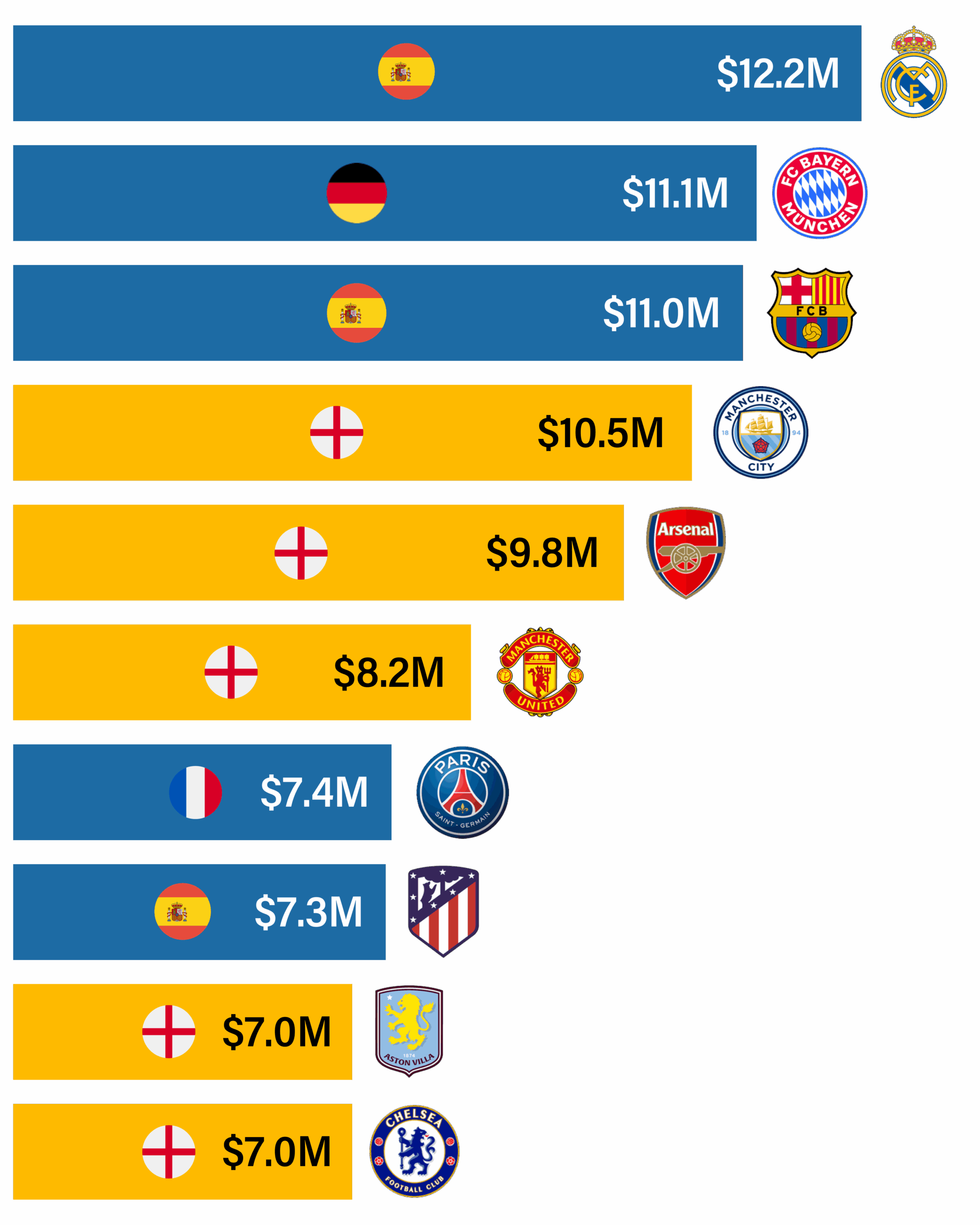
But what truly sets the league apart is how mid-table and lower-ranked Premier League clubs regularly pay at levels that far exceed those of similar teams across Europe. For example, Crystal Palace, with a median salary of $3.1M, pays significantly more than a club of comparable size and stature in Serie A such as Torino, whose median stands at $1.8M. Even a historical team like Valencia in Spain can only command a median salary of $1.9M in the 2025/2026 season.
This highlights the extraordinary financial depth of English football, where even the bottom half of the table operates with payrolls that rival or exceed top-tier squads elsewhere on the continent.
The disparity between the top and bottom of the Premier League remains wide, with the top five clubs paying 4.4 to 6.6 times more than the lowest-ranked team, Sunderland. Yet compared to other European leagues, where a handful of dominant clubs capture most of the financial power, the Premier League’s middle and lower tiers are exceptionally well funded. This balance fosters both sporting parity and financial sustainability.
Troubled UK Domestic Economy Threatening EPL’s Leadership
For the last 15 years, Europe as a whole has grappled with weak domestic economies, sluggish GDP growth and decreasing consumer purchasing power. While the UK economy’s relatively better performance over that period played a part in the EPL’s financial strength, the league’s growth rates easily outpaced those of its domestic economy.
Nevertheless, the Premier League’s compensation growth has started to slow. Over the past five years, median salaries have increased at a 4.0% compound annual rate, just short of the 4.5% annualized inflation rate in the United Kingdom. The league’s most recent domestic broadcasting cycle brought only a 4% annual increase, suggesting that future pay expansion will increasingly depend on growth from international markets.
For the Premier League to maintain its financial lead in the face of an ailing UK economy, it must redouble its efforts to grow its global audience. A focus on the booming US market may be one way to get there.
Holding league games in the US and other high potential countries, a strategy that has worked very well for the NFL in the last few years, might be another potential road to further increase broadcaster interest globally and continue growing its international fandom – and income.