

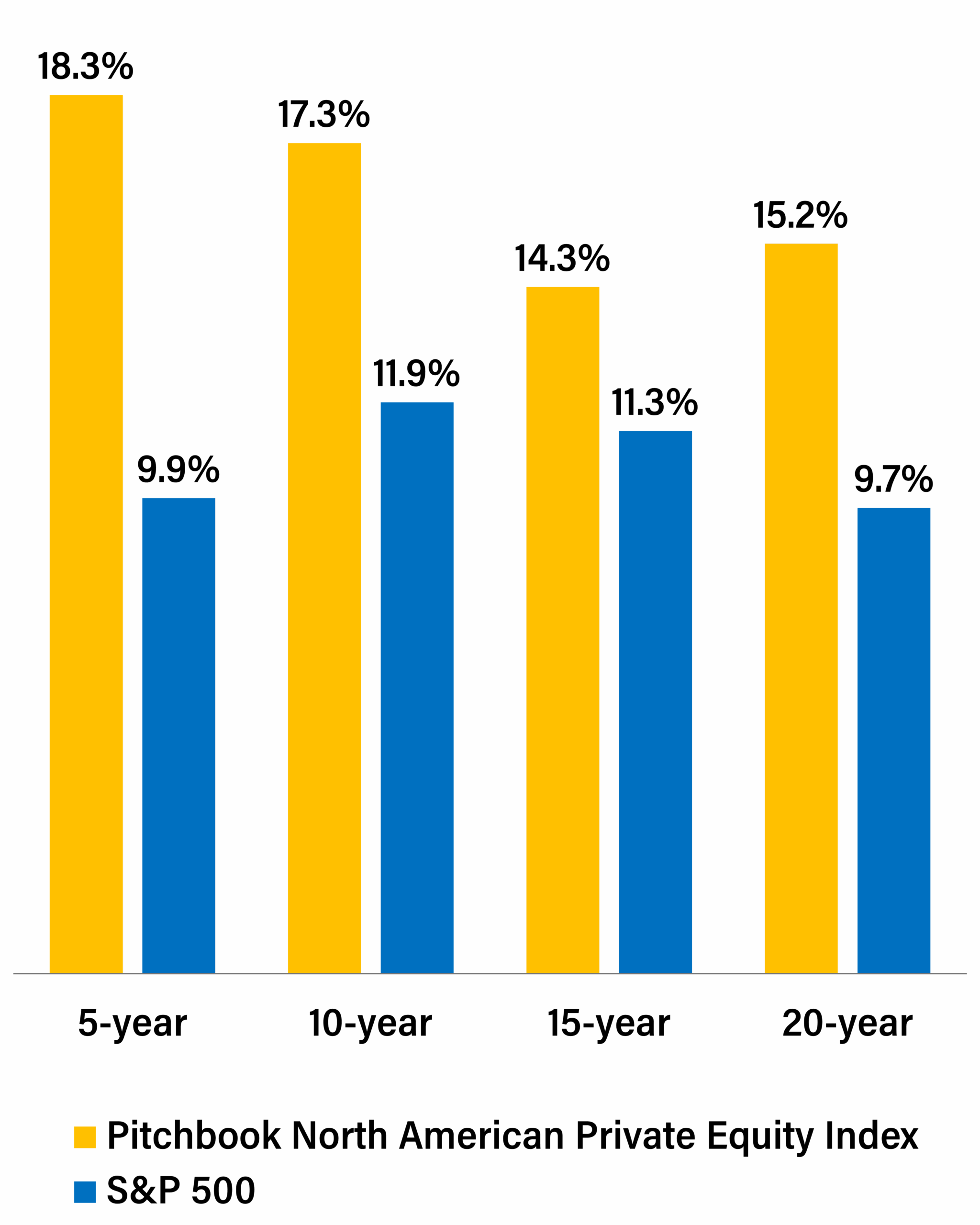
Private Equity has consistently outpaced the returns of the S&P 500 over the last two decades. As returns compound powerfully over time, not investing in the asset class can cost investors dearly over the long term.
For individual investors, Private Equity’s relative illiquidity and longer holding periods can can be too much constraint as they go through the ups and downs of life. Nevertheless, for physicians, who have longer careers and income stability compared to other professions, allocating a part of their portfolio to Private Equity deserves consideration.
A History of Outperformance
As of December 2023, the PitchBook North American Private Equity Index outperformed the S&P 500 in the last 5, 10, 15, and 20-year periods. According to Cambridge Associates, as of Q3 2024, Private Equity funds have delivered a ~15% Compounded Annual Return (IRR), compared to a ~7.8% IRR in the public markets. For doctors who can afford to commit capital over the long term, that premium can fuel substantial wealth creation.
Time Horizons & Holding Periods
Private Equity funds’ typical 5–7 year holding period, during which investors’ capital is fully committed to the funds and therefore illiquid, can be a hurdle for many individual investors. It is certainly not a good fit for everyone. Nevertheless, for physicians, allocations to PE of between 15-20% of the total portfolio would still leave significant liquidity and flexibility within the portfolio for emerging opportunities and emergencies while providing considerable exposure to the asset class.
Direct and Indirect Private Equity Exposure
The growth in the Private Equity industry has brought with it a large variety of strategies, focus industries, and funds in which to invest. While generalist funds were the norm in the early years, these days many funds concentrate on specific industries and/or regions.
While the mega funds of firms such as Blackstone or KKR typically dominate headlines, there has been extraordinary growth in hyper-focused middle market and lower middle market Private Equity funds targeting sectors and regions that they view as more promising but can’t necessarily be targeted by the biggest funds because of their smaller size. Blue-collar services-focused Private Equity funds, in particular, have been growing in popularity over the last decade.

Mega funds are typically reserved for institutional investors and pension funds, while the smaller funds are much more open to direct investing by high-net-worth individuals. Investing in them has been a primary way for HNW investors to avoid layers of intermediation and have more direct exposure to returns. Another way investors are getting exposure to Private Equity is through the publicly-traded shares of PE giants such as Carlyle and TPG. While investing through the public markets addresses the liquidity issue, the overall performance of the firms can vary significantly from those of their Private Equity operations, as many of the largest asset managers today are diversified financial companies with operations in multiple asset classes rather than pure-play Private Equity firms.
Accessing compelling Private Equity opportunities continues to be a challenge for many high-net-worth investors. In the last few years there has been a growing number of Private Equity firms marketing their funds through investment advisors, although mostly to those focused on ultra-high-net-worth individuals. With growing awareness of the industry, we expect for there to be increasing demand for the asset class among individual investors over time. Still to be determined is whether the industry will open the doors wider for investors who could benefit from the higher returns.
Handal Dunaway: Specialized in Helping Physicians Invest in the Financial Markets
We understand that for doctors, dedicating enough time to finding and managing investments on top of the time you dedicate to patients, paperwork, and family obligations can be overwhelming—and we are here to help. Our team specializes in working with physicians and doctors in the US and across the world, helping them build wealth through personalized investment strategies adapted to the particular needs of every client. We take the time to understand doctors and their unique needs, and work with them throughout their financial journeys.
You’re already doing one of the hardest jobs in the world. We’re here to help you achieve the long-term financial success you’ve worked so hard for.
Physicians, Physicians, Physicians, Physicians, Physicians, Physicians, Physicians, Physicians, Physicians, Physicians, Physicians, Physicians, Physicians