
The numbers don’t lie: MLS players are dramatically underpaid compared to their peers in other major US leagues. Our 2025 MLS Player Compensation Report shows that despite soccer’s growing popularity in America, the league’s players are still earning a fraction of what NFL, NBA, MLB and even NHL athletes take home. The question is why, and whether the Apple TV+ deal — touted as MLS’s financial breakthrough — is actually keeping the league, and its players, from reaching their potential.
$2.5B Sounds Big — Until You Do the Math
When MLS announced its 10-year, $2.5B media rights deal with Apple, it was celebrated as a watershed moment. But strip away the headline number and you’re left with just $250M per year — only about $8.3M per team, per year.
Median Compensation by Soccer League
(Top Divisions) 2024-2025 Season
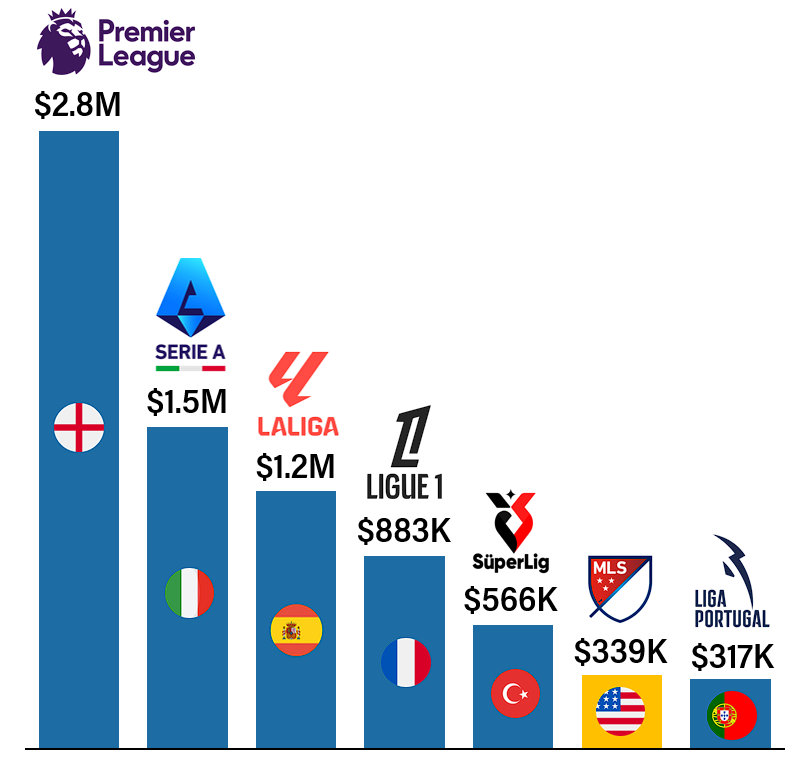
That amount is shockingly low when compared to other leagues. The NFL takes in over $10 Billion per year from media rights, the NBA just finalized a new media deal that will bring in ~$7B annually, and even the NHL generates over $1B. For a league trying to compete for talent with global football giants, $250M/year simply doesn’t move the needle.
The Problem Isn’t just the Paywall — It’s the Price too
Much of the criticism has focused on the decision to place the league behind a paywall with a small-ish streamer. That’s a huge problem for the overall growth of the league but being exclusive to Apple TV+ would be a smaller problem if the check was big enough. The bigger issue is that the payout is too small to justify locking up the entire league for a decade with a single partner that can’t offer the league the mass exposure it needs to grow and be competitive worldwide.
The MLS took a bad deal because it was the guaranteed one: a safe, predictable paycheck that made for a good headline, but that came with very limited growth potential. $8.3M per year will not come close to placing the teams in a financial position to compete for top global talent.
As a result, the league is now locked into a decade-long exclusivity deal with Apple TV+ — a streaming service that is small, lacks depth and diversity in its content library, and is hardly positioned as the go-to platform for live sports. In doing so, MLS traded growth upside for short-term certainty.
What MLS Could Have Done Instead
MLS had other options — options that might have paid less guaranteed money upfront but would have been far more powerful for growing the sport in the US:
- Partner with an Established Streamer for a lower guaranteed fee – Netflix, Disney or YouTube could have aggressively marketed the MLS, integrated it into their recommendation engines and raised its popularity, if the league had forgone a high guaranteed fee, prioritized audience size and taken the risk. It’s hard to imagine the MLS failing to generate $250M/year in ad revenue with platforms of that scale marketing it and pushing it.
- Free Access + Ad Model – Another alternative, in a sports world increasingly full of paywalls, would have been for the league to self-produce the broadcasts and stream matches for free on every streaming platform simultaneously. Imagine going to Netflix, HBO Max, Paramount+ and even Youtube, Facebook or Twitch and offering to give them premium sports content for free, in exchange for a high share of the ad revenue. That would have maximized the advertising potential, increased sponsorship opportunities for the teams and athletes, and raised awareness of the league by exposing it to new audiences. Again, in such a scenario, it’s hard to imagine the MLS failing to generate the $250M they are currently getting from Apple.
- Shorter Deal Terms – A 10-year lock-up is a lifetime in today’s media world. A shorter 3-5-year deal would have allow MLS more time to negotiate a better deal, especially as streamer competition for live sports rights intensifies.
Why This Matters for Players
Player salaries are directly tied to league revenue — and right now MLS is distributing from a very small pie. Median guaranteed pay in 2024 was just $339,000, compared to $1.2M in the NFL, $1.3M in MLB, and $6M in the NBA.
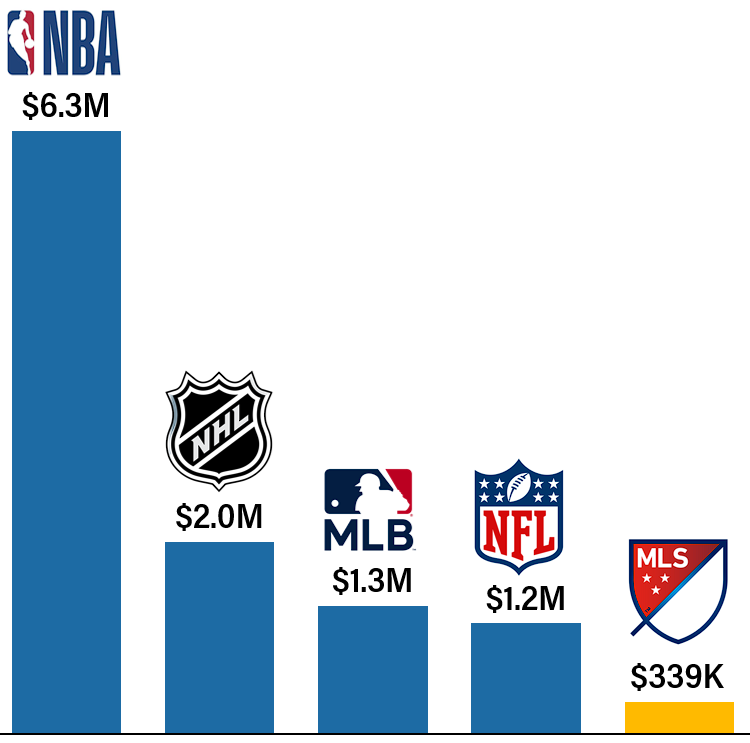
Bigger audiences lead to bigger sponsorship deals, better merchandise sales, and more leverage for players in collective bargaining. By settling for a low-paying deal with limited reach, MLS effectively capped the league’s ability to increase player pay.
The Way Forward
The next rights deal, or if (hopefully) the Apple TV+ deal ends prematurely, the league must prioritize growth and engagement, not just guaranteed money. For the amount Apple is paying, it’s a risk worth taking.
What should be the MLS’ primary objectives in its next media negotiations:
- Maximizing Reach – Get matches on as many platforms as possible, even free-to-watch, to expand the fan funnel.
- Ad Revenue Sharing from Day One – Rather than relying on fixed rights fees, MLS could give streaming rights for free (or very cheap) to multiple major platforms in exchange for a high guaranteed percentage of advertising revenue on every broadcast. This way, the league benefits directly from every additional viewer without needing to hit subscriber milestones like it does now.
- Preserve Negotiation Leverage – Avoid decade-long deals that lock the league into outdated terms and miss out on future bidding wars, especially right now that the league is growing a needs flexibility.
A League at a Crossroads
MLS sits at a critical juncture. This is a country where millions of kids play soccer, where the soccer-loving Hispanic population is booming, and where the appetite for the sport is stronger than ever. The league has the chance to become a cultural force — but it won’t get there by hiding behind a small, limiting paywall for paltry fees.
To unlock its potential, MLS must think bigger, take risks, and bet on itself. Maximizing exposure — even at the expense of guaranteed revenue — is the path to making MLS a global property and turning its players into stars worthy of the world’s game.
Sources
- https://sportsepreneur.com/nfl-partner-web-media-rights
- https://www.spglobal.com/market-intelligence/en/news-insights/research/as-nfl-revenue-rises-current-media-rights-deals-ensure-future-success
- https://www.sportsbusinessjournal.com/Daily/Closing-Bell/2021/03/18/NFL-rights
- https://www.reuters.com/sports/basketball/nba-nears-tv-deals-worth-76-billion-wsj-reports-2024-06-05
- https://www.nytimes.com/athletic/6299679/2025/06/18/nba-espn-tnt-deal-contract-viewership-ratings/
- https://www.theguardian.com/sport/article/2024/jul/26/data-dollars-and-dunks-why-nbc-amazon-and-espn-paid-76bn-for-nba-rights
- https://www.nba.com/news/nba-media-agreements-2024
- https://www.nytimes.com/athletic/6299679/2025/06/18/nba-espn-tnt-deal-contract-viewership-ratings/