

Established physicians can be among the most stable professionals in the economy, which opens them up to attractive, high-performing asset classes that are not appropriate or available for investors with other backgrounds. Yet many doctors default to familiar asset classes—public equities, municipal bonds, or direct ownership of real estate—without exploring less conventional, potentially high-return vehicles like Search Funds.
But do Search Funds truly align with physicians’ unique financial profiles and long-term wealth goals? The answer is nuanced, as we believe it would be a worthwhile asset class to invest in for some physicians, but not for all.
What Is a Search Fund?
A Search Fund is an investment structure in which an entrepreneur—frequently an MBA graduate—raises capital to acquire and operate a small-to-medium sized business with strong fundamentals and room for growth. The model has four distinct phases:

- Search: The entrepreneur spends 1–2 years identifying the ideal acquisition target, funded by early-stage investors.
- Acquisition: Equity is provided by investors, with debt financing covering the rest of the purchase price. Investors typically retain about 75% of the equity; the entrepreneur receives ~25% “sweat equity” for running the business.
- Operation & Growth: The entrepreneur works full-time to scale the company, often through operational efficiencies, marketing improvements, and strategic acquisitions.
- Exit: After 5–7 years, the business is sold—often to private equity—returning capital and profits to investors.
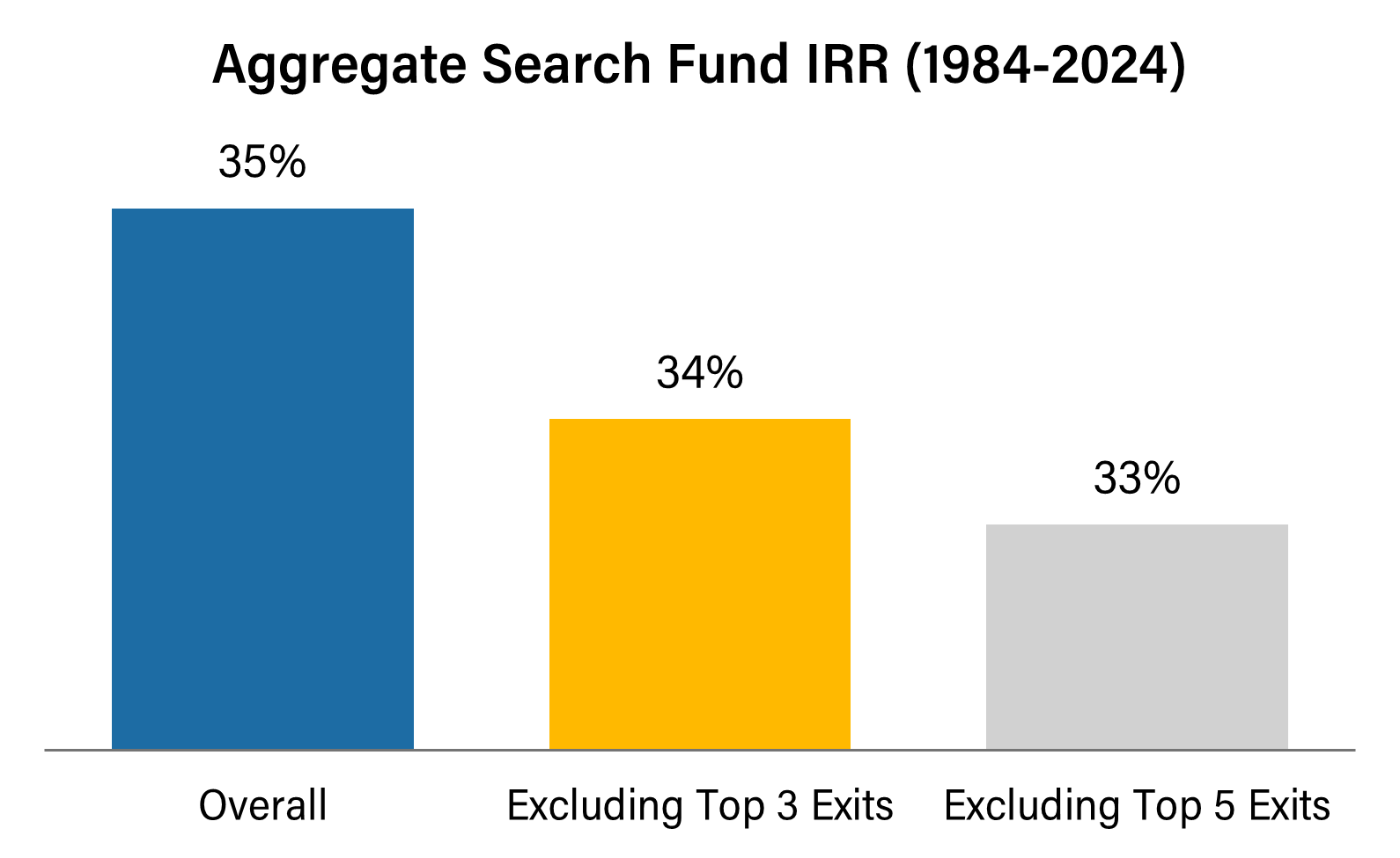
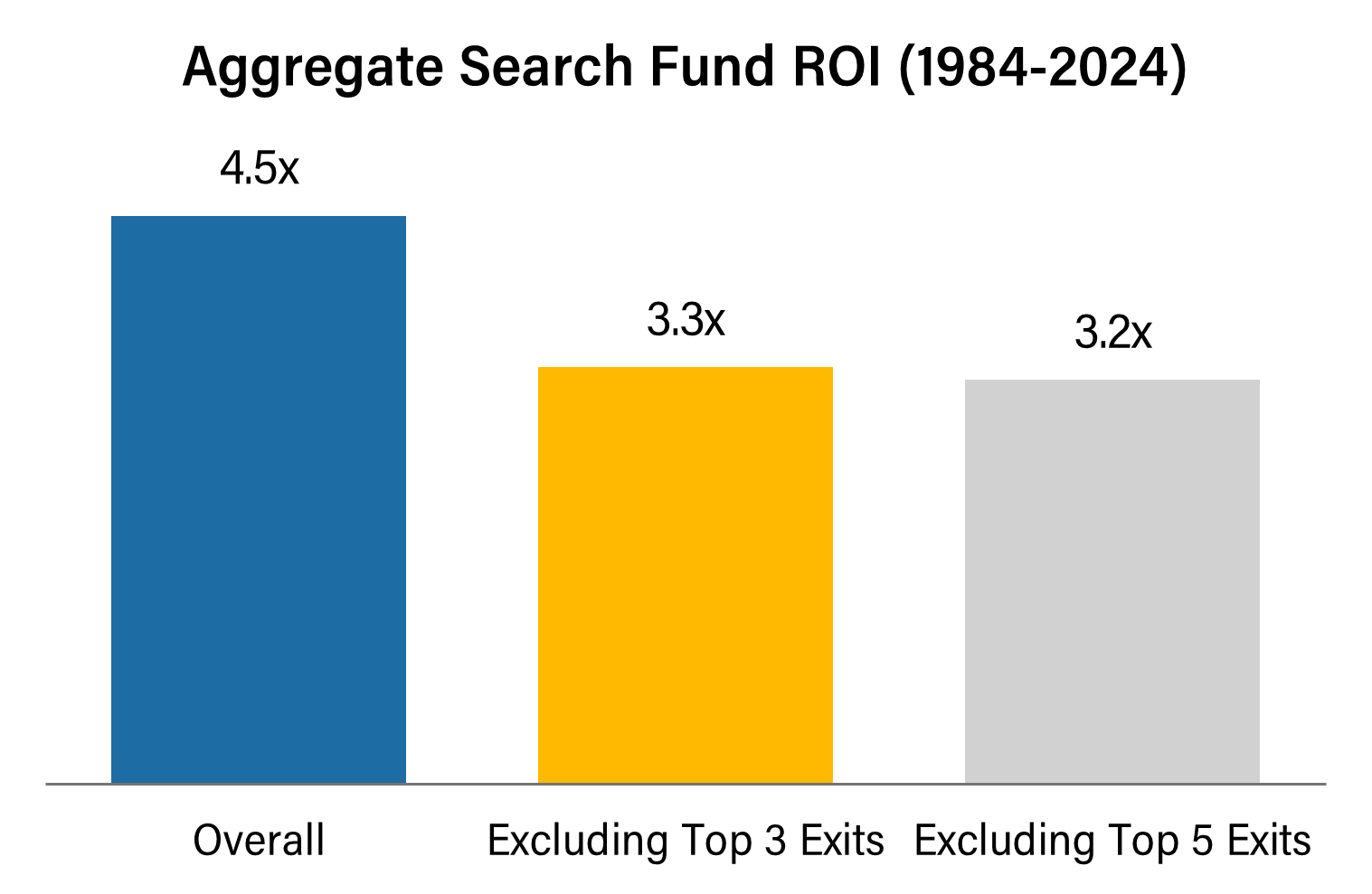
Historically, Search Funds have been one of the highest-performing asset classes in private markets, with a 35.1% annualized IRR e a 4.5x average ROI since 1984, according to Stanford’s 2024 study on North American Search Funds.
Why Search Funds Might Appeal to Physicians
On paper, Search Funds check several boxes for doctors:
- Passive Investment with Professional Oversight: The operational heavy lifting is handled by the entrepreneur, allowing physicians to invest without sacrificing their already limited time.
- Exposure to Profitable, Private Businesses: Unlike venture capital startups, most search fund acquisitions are already cash-flow positive, often in recession-resistant sectors like healthcare services, B2B outsourcing, or niche manufacturing.
- Potential for Superior Long-Term Returns: For physicians who are comfortable with illiquid periods in exchange for higher potential returns, the historical performance of Search Funds has outpaced public equities and many traditional alternatives.
- Industry Insight Advantage: Physicians may be uniquely positioned to assess opportunities in healthcare-related businesses—urgent care clinics, diagnostic labs, specialized medical services—where their expertise adds due diligence value.
The Caveats—and Why Search Funds Aren’t for Every Doctor

Despite their appeal, Search Funds are not a one-size-fits-all solution for physicians. Several challenges should be weighed carefully:
- Illiquidity: Once invested, capital is typically tied up for 5–7 years. This can be problematic for doctors with uncertain timelines for large expenses such as practice expansion, real estate purchases, or children’s education. Any capital invested should therefore not be one that would be needed in the near-term.
- Concentration Risk: Search Funds often involve investing in a single company. While returns can be outsized, so can losses if the operator underperforms or the sector faces disruption, making investment due diligence essential.
- Dependence on Operator Skill: The success of the investment rests heavily on the entrepreneur’s execution. A skilled operator is needed to get results and avoid value erosion.
- Deal Access: The highest-quality search fund operators are often oversubscribed, meaning physicians that work with advisors without established networks within the search fund space may end up with less proven managers.
Where Search Funds Fit in a Doctor’s Portfolio
For physicians with a solid financial foundation, Search Funds can be a strategic allocation within the private equity slice of their portfolio. They may be best suited for:
- Doctors in mid-to-late career stages with long-term investment horizons.
- Those with a higher capacity for illiquid investments and a desire to diversify beyond public markets and direct ownership of real estate.
- Physicians willing to commit capital to high-potential operators to pursue outsized returns.
For early-career physicians or those prioritizing liquidity and stability, the risk-return trade-off may not justify the allocation, especially when other private market vehicles (e.g., diversified private equity funds or healthcare-specific private credit) can offer more diversification with less operator risk.
Handal Dunaway’s Perspective
Na Handal Dunaway, we don’t view Search Funds as a universal solution for physicians—but rather as a high-potential tool for the right investor profile. When matched with highly-skilled operators and well-structured deals, Search Funds can deliver exceptional returns. However, they demand selectivity, due diligence, and a longer-term investment horizon.
For doctors considering this path, our role is to provide access to the top-performing searchers, structure allocations to limit concentration risk, and integrate these investments into a broader, physician-tailored portfolio strategy. In medicine, precision matters. In investing, the same is true. Search Funds may not be the prescription for every portfolio—but in the right dosage, they can be a powerful component of long-term wealth building for physicians.
Sources and Case Studies
- Kelly, P., & Heston, S. (2024). 2024 Search Fund Study. Center for Entrepreneurial Studies, Stanford Graduate School of Business. CASE E-870. Retrieved from Stanford GSB.
- Kowalewski, A.-S., Kelly, P., Simon, J., & Johnson, R. (2024). International Search Funds – 2024: Selected Observations. IESE Business School. Retrieved from www.iese.edu
- Gbadebo‑Smith, O. (n.d.). Why More Entrepreneurs Are Choosing To Build Search Funds Over Startups. Toptal. Retrieved from https://www.toptal.com/management-consultants/startup-funding-consultants/search-fund
- Calcaterra, C. (2025, May 5). Understanding Search Funds. CAIA Association. Retrieved from https://caia.org/blog/2025/05/05/understanding-search-fundsRozenrot, E. (2005). Note on Search Funds (Case No. 5-0034). Tuck School of Business at Dartmouth College. Written under the supervision of F. Wainwright.