

When most people think about athlete compensation, blockbuster NFL player contracts immediately come to mind. It is, after all, America’s dominant sport — the Super Bowl is the most-watched broadcast each year, media rights are valued in the hundreds of billions, and franchise valuations continue to climb.
Yet, when we examine median player compensation across US sports leagues in 2025, an unexpected story emerges: The NHL’s median salary of $2.0 million easily surpasses the NFL’s $1.2 million.
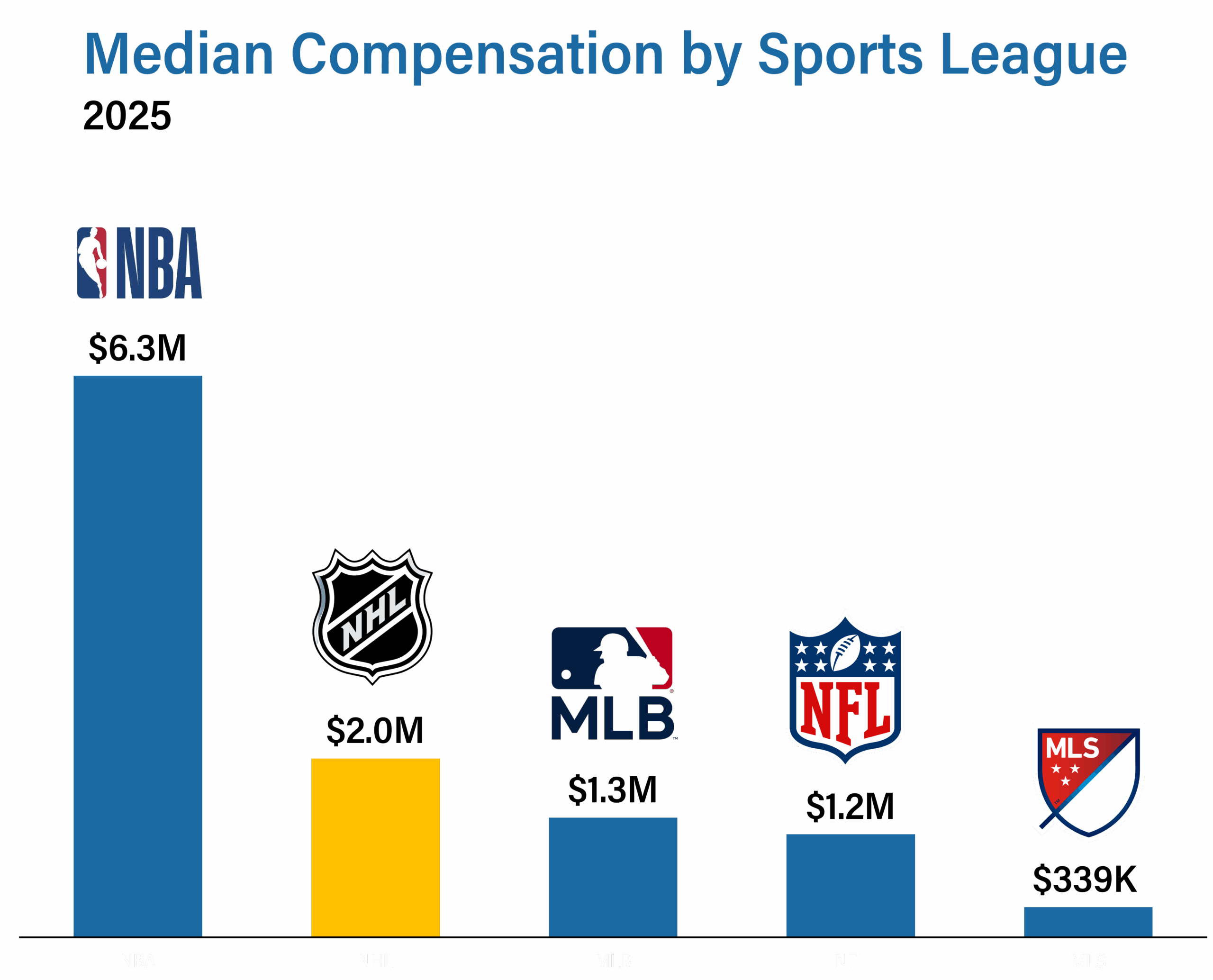
At first glance, this looks counterintuitive. How can hockey players — operating in a smaller market, with far less television reach — earn more than football players on average? The answer lies not in the scale of revenues, but in the structure of rosters and contracts.
Roster Size and Salary Distribution
The NFL carries 53 active roster spots. The NHL, by contrast, has 23. When revenues are divided across fewer players, the median share per athlete rises even if the total revenue pie is smaller. This partly explains why a league that generates significantly lower revenues than the NFL has higher median compensation per player.
The Security of Guarantees
Beyond roster sizes, contract structures matter even more. NHL contracts typically carry longer terms and higher guarantees. It is common to see multi-year deals that provide players with security even through periods of injury or underperformance. The NFL, on the other hand, is built on non-guaranteed contracts, with much of player wealth coming from signing bonuses and front-loaded structures that can evaporate quickly if a player is cut out or injured.
Stability vs. Volatility
The result is a starkly different wealth trajectory. NFL players face short average careers of just over three years, high injury risk, and limited contract protection. Their wealth strategies must start from volatility and fragility. NHL players, by contrast, enjoy steadier career arcs. Five- to eight-year contracts allow not only for consistent income but also for thoughtful long-term planning and compounding strategies.
Beyond Revenues: The Real Lesson
This comparison highlights a broader truth about professional sports: athlete wealth is determined less by league revenues than by the intersection of roster economics and contract design. The NFL is a league of massive cash flows but thin player stability. The NHL, while operating on a smaller stage, creates a more durable middle class of athletes.
Implications for Athletes and Wealth Planning
For NFL players, the task is defensive — preserve capital during a compressed, uncertain earning window. For NHL players, the opportunity is different: leverage stability to grow diversified portfolios that extend beyond the rink. The lesson is that in sports, as in investing, structure matters as much as scale.
Handal Dunaway’s Perspective
At Handal Dunaway, we see these contrasts not as curiosities, but as case studies in financial architecture. The way income is structured — whether volatile or stable, guaranteed or contingent — shapes the long-term wealth trajectory of every athlete. Our role is to help clients translate these structures into tailored strategies: preserving capital when careers are short, amplifying compounding when income is steady and ensuring that temporary earnings evolve into enduring wealth. The NHL and NFL remind us that while talent fuels opportunity, structure defines legacy.