

Private Equity has outperformed public markets for more than two decades. For investors who can afford to be patient, the compounding effect can materially increase long-term wealth.
A key reason behind Private Equity’s above-market returns is their focus on operational transformation and a longer-term view of investments in their businesses. Naturally, those kinds of changes and investments require extended periods of illiquidity, which disqualifies a large share of individual investors from investing in the asset class.
This raises a simple but important question: Who is actually well positioned to invest in Private Equity?
Private Equity and Lock-Up Periods
Private Equity funds typically lock up capital for 6 to 8 years, and often return the bulk of proceeds near the end of a fund’s life. For individual investors, this structure demands higher income stability or larger portfolio sizes. Investors who have large foreseeable expenses such as childcare, tuition, a home purchase, or whose incomes are high but volatile, are rarely the right fit.
The ideal Private Equity investor has a portfolio that is at least 4-5x larger than their annual household expenses. They are not relying on near-term liquidity to navigate unpredictable life events. They may have adult children or no dependents. They are past the life stage of volatile cash flow. In other words, they can afford to let capital sit for a decade without feeling its absence.
Un historial de rendimientos superiores As of December 2023, the PitchBook North American Private Equity Index has outperformed the S&P 500 over 5-year, 10-year, 15-year, and 20-year periods. Cambridge Associates reports that North American Private Equity funds delivered a ~15% Compounded Annual Return (IRR) in Q3 of 2023 compared to roughly 7.8% for public markets.
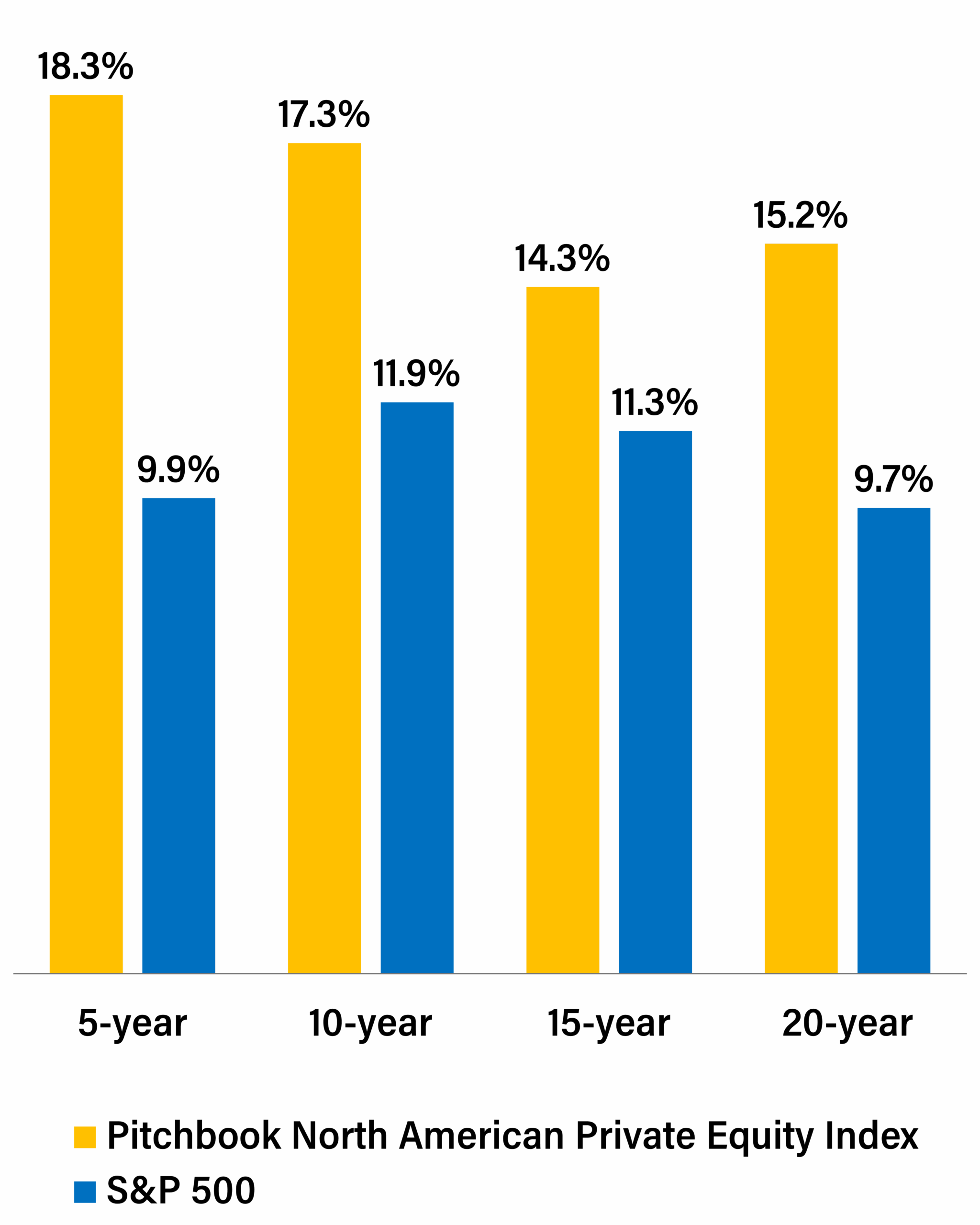
For investors with the time horizon and discipline to stay invested, that performance gap compounds into a meaningful difference in long-term wealth.
Who Is Best Positioned: Investors with Long Careers and Predictable Cash Flow
Private Equity demands financial stability, long planning horizons, and an investor profile that can tolerate delayed liquidity. Only a subset of households naturally meets those conditions.
Physicians are a prime example. They have long careers, steady earnings, and fewer large financial shocks later in life. But they are far from the only group that fits the profile. The list can include:
- Partners in accounting and law firms
- Senior technology professionals with liquidity events like IPOs or vested equity
- Business owners with mature, profitable companies
- Investors with adult children and no major obligations on the horizon
These are individuals who can typically better endure extended periods of illiquidity and still maintain flexibility for unforeseen opportunities or emergencies.
Exposición directa e indirecta al capital privado
Private Equity has evolved significantly. Beyond mega funds like Blackstone and Apollo, a growing universe of middle market and lower middle market managers focus on niche sectors that large funds cannot access. These smaller strategies often accept capital directly from high-net-worth investors seeking less intermediated exposure.
Some investors choose to access the sector indirectly through publicly traded shares of Private Equity firms such as TPG or Carlyle. While these vehicles solve the liquidity issue, their stock performance often reflects the broader business mix of the firm, not the specific performance of its Private Equity funds.
Access remains uneven. Many compelling funds are still relationship driven. In recent years, more firms have expanded their distribution through advisors, mostly those serving wealthier families. As awareness grows, demand will likely rise. The remaining question is how far the industry will open its doors to individuals who could benefit from the return premium.
Handal Dunaway: Helping Investors Build Long-Term Wealth By Building Portfolios Tailored to their Needs
Private Equity is a good addition to a portfolio only when an investor’s financial stability, liquidity structure, and time horizon align with its long holding periods. When those conditions are in place, the asset class can reinforce long-term portfolio resilience and return potential.
En Handal Dunaway, we build portfolios tailored to the individual investor’s needs and financial objectives. We are focused on what better fits every client and in maximizing long-term wealth creation.