
Doing business in America is complicated. Thinking of building a house or a small apartment building? Be prepared to navigate a thicket of regulation and red tape. You have to somehow track all federal, state, local and even HOA laws and rules. So many rules it’s very likely those poor inspectors don’t even know a fair number of them. It’s no wonder so little housing gets built.
Are you skilled at manicuring nails and see the need for a nail salon in your neighborhood? Did you know many states require hundreds of hours of training just to get licensed? For example, Texas requires 800 hours of courses for a manicurist license, while Florida requires 180 school hours for a nail specialist registration. If that’s too hard, what about starting a restaurant? Oh, you’re in for a doozy. All of these complications are before you even get to the financial and operational hurdles of starting and running a business, which are hard enough.
Overregulation and over-complication is turning the nation into the land of unpursued opportunity. The mountain of hurdles current and aspiring businesses face ultimately end up in less competition in the marketplace. Low competition almost always translates to higher prices and lower quality of products and services. How we got here is a combination of good and bad intentions placed on top of each other over years.
Laws and regulation are often set in reaction to negative events that unfolded. Some operators of X business type abused customers in a particular way, and the consequence is not only punishing the bad actors, but also creating a regulatory framework that ensnares good and bad operators alike. Setting guidelines is sometimes necessary, but almost certainly you don’t need thousands of encyclopedia-sized books of laws to deal with issues.
On the other hand, laws and regulations are too often set as a result of lobbying campaigns by existing businesses. Ironically, businesses that are already established love regulation that prevents competition, but hate regulation that raises their own costs. Regulation for thee, but not for me. They typically use “doomsday” narratives of what will happen if they have to face the evil of competition to scare the public and politicians into submission. If that doesn’t work, well-timed political donations never hurt.
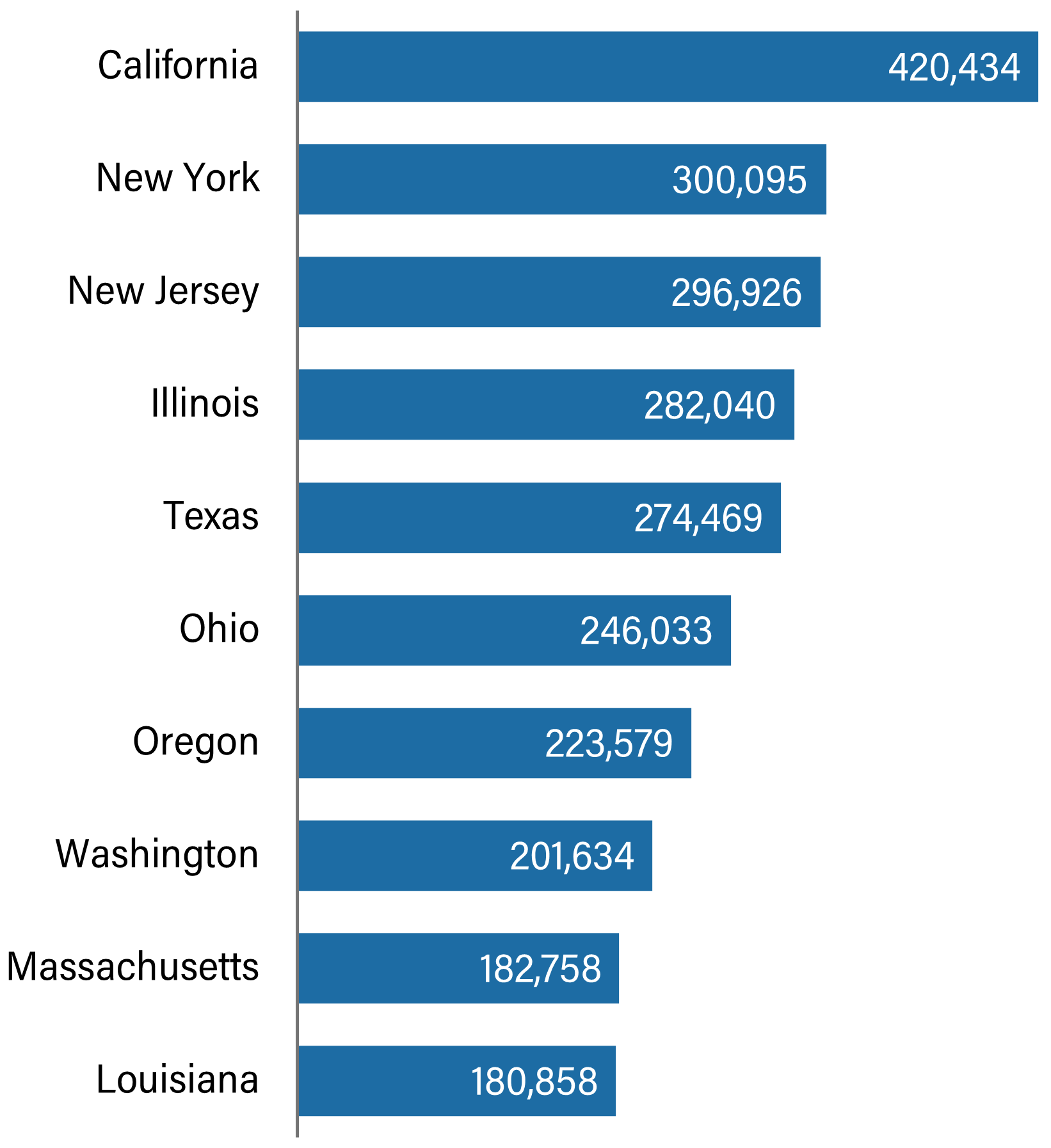
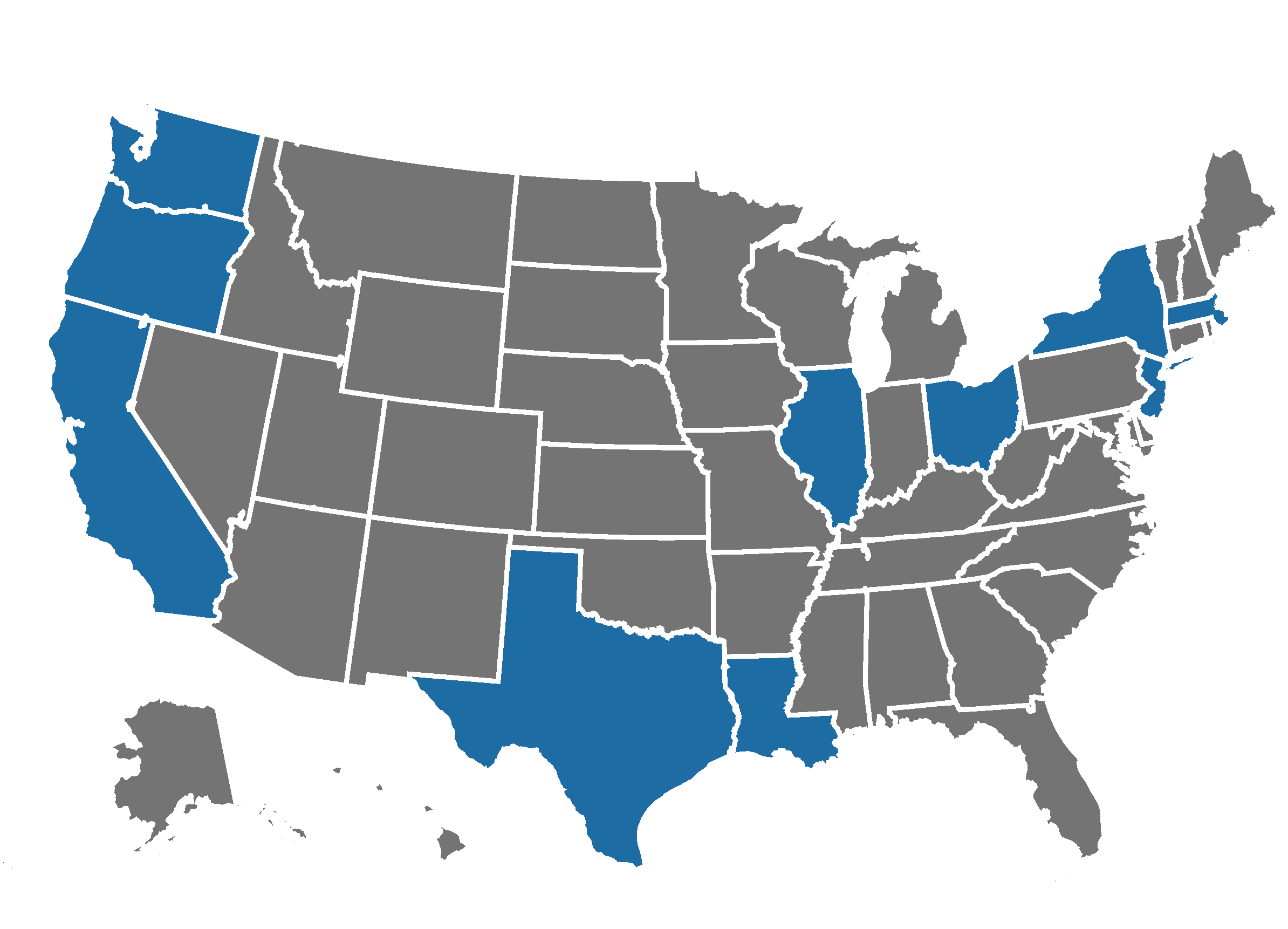
There isn’t a single, authoritative count of all federal laws and regulations. The Code of Federal Regulations contained ~1,000,000 regulatory restrictions in 2023, and the Federal Register printed 106,109 pages in calendar 2024. At the state level, restriction counts vary widely—California ~420,434, New York 300,095, New Jersey 296,926, Illinois 282,040 y Texas 274,469 in 2023—before you even get to local ordinances and agency guidance, which underscores how Americans really do give regulation-loving Europeans a run for their money.
Top 10 Most Regulated States in the US
By Number of Active Regulatory restrictions, (2023, Estimate)
The Way Out? More Democracy.
1) “Sunset” laws and regulations automatically every 10 years
A good first step is realizing that tackling and tinkering with regulations one by one is going to be impossible. There are thousands of laws in the book that are obviously not going to be reviewed individually. Too many businesses who benefit from regulation don’t want more competition and will try and fight tooth and nail over specific details, making surgical regulation reform exceedingly hard and politically unrealistic. Like a basement storage full of ‘important’ and “one-day-we’ll-need-it” tools, sometimes it’s time for a full clean-up and a fresh start.
Currently, when laws are passed, they are set in stone, even though the world keeps turning and things change with time. You need intentional action by lawmakers to modify them. Senator Rick Scott from Florida a couple years ago proposed automatically sunsetting laws every 5 years, meaning, absent intentional action by lawmakers, they would cease to be laws automatically after 5 years of passage. This is a great idea, as laws that are brought upon as a result of a specific event will have their time to shine or, if deemed excessive, will go away without any action necessary from lawmakers. Although 5 may be too low a number, 10 year sunsetting would allow a new generation of voters, through their elected officials, adapt the regulations to the realities of their time and their preferences.
Automatic sunsetting of laws would force politicians and bureaucrats to prioritize the regulations that are essential, and rethink what may be unnecessary or overreaching. Given how the government is structured and our beautiful democracy, unpopular laws passed without broad consensus by a governing party 10 years before may have to be discussed in a new political reality. This would likely lead to some moderation and more thoughtful processes when designing laws originally, so that they can withstand the passage of time. It can also help politicians avoid tough votes for laws that they think should go away but don’t want to be on the record opposing them.
2) Mandatory Referendums Every 2 Years
Voters in the US go to the polls every 2 years. Representative democracy as it stands today means that you vote for a person you hope will pass laws to align with your worldview. For the House of Representatives, you get to re-elect them or vote them out every 2 years, Governors and Presidents every 4 and Senators every 6. The problem most voters face today is that they have to make significant compromises on the issues. Yes, they hate 2 positions this candidate has, but support the other 3 positions, so they have to hold their nose and vote for the most aligned, with little say on the other issues they disagree with. That problem inherent with representative democracy can be solved with more democracy: Referendums.
Referendums are a part of many democracies, most prominently Switzerland, where voters get direct say on the actual laws and can vote them down even if they vote for a politician that supported them for other reasons. In the US, they have gained prominence on the state level in issues like recreational marijuana usage and abortion, which cross traditional party lines and have helped the public have a direct say on them without having to vote out their congressman.
The 2-year election schedule actually makes it easier for this to come to reality. It could be established that laws passed in the last 2 years at the federal, state and local go up to voters for an up-or-down vote. Since it’s only 2 years, it’s easier to actually put that on ballots and not overwhelm voters, and the issues are fresher and the effects more noticeable.
Establishing referendums as the norm could be beneficial for both voters and politicians. Politicians often face a significant issue with primary elections. Primaries make it more difficult for them to put out moderate positions that may be more popular with the whole of the electorate, as they have to be conscious of primary voters who tend to be more extreme in their positions. With referendums, they can continue passing laws with that primary calculation in mind, and if the voters don’t like them they can vote them down piecemeal. The politician can then wash her hands in front of primary voters, and reduce backlash from the broader electorate.
For voters, it would allow them to reduce the amount of compromise they are forced to make on the issues. If they support a Democratic candidate for his pro-housing positions, for example, but dislike a union-backed education-related law he had to vote for to avoid getting primaried, they can vote down the law and keep supporting the candidate. A Republican voter that supports GOP traditional pro-business positions but dislikes their tariff executive orders can vote down the tariff orders while keeping her support for the candidate.
With referendums as the norm, politicians would be forced to either create laws that have broad consensus or go out and sell the benefits of the specific laws to the voters. It would also invite the voters deeper into the democratic process by having them decide the policies they want, without having them get tangled up with other issues.
3) Accelerate the Judicial Process and Expand the Courts
The US Judicial System is one of the major reasons behind US leadership in the business world. Companies and individuals who feel they have been wronged by others have the right to go to a judge, confront their counterpart and make their case. It doesn’t cost much to literally sue somebody, and you technically don’t need an attorney to sue them, although it’s probably advisable to have one.
In a way, it’s as democratic and American as it gets: Johnny the small business owner can sue a publicly-traded conglomerate and have a shot at winning if he’s in the right and prepares for the lawsuit. Nevertheless, that freedom has led to a couple of issues:
- It can take years to get resolution to an issue, which exacerbates costs for both the plaintiff and the defendant and discourages people with legitimate claims from even trying to get justice.
- Given how high attorneys fees are, enterprising attorneys have figured out that if you sue a big company and just manage to have the process extend long enough so that it’s a significant cost for companies, they will settle even though they weren’t in the wrong. That’s unfair, but judicial delays and extended judicial processes have made this a cynical calculation for both.
At the heart of both issues are the delays, which are often not mandatory but rather a reflection of the high workload judges and courts face. They are overwhelmed with cases. When companies have significant delays because of personnel issues, the easier solution is to hire more. That’s clearly something the judicial systems urgently needs: More judges, more clerks, more personnel, more investment. Double, triple, whatever is necessary.
The Federal government spends $9.4 billion in the federal judicial system, which represents approximately 0.03% of 2024 GDP. If they tripled that, for example, it would represent approximately 0.1% of 2024 GDP, and 0.3% to 0.6% of the total federal budget, but could have immense impact for businesses and individuals and allow more people to pursue justice1.
In exchange for that, it is more than reasonable for the taxpayer to ask judges for time limits on legal processes. It would also encourage judges to make the parties move faster. If business lawsuits had a limit of, say, 90 days from start to finish, it would be a transformational change that would decrease the need for unfair settlements. It would allow small and medium businesses to be able to afford to have their day in court when they are wronged. It would decrease legal uncertainty for businesses and make disputes reach faster resolutions.
With legal certainty, businesses are able to invest with higher confidence and invest more on their business and employees rather than on law firms. Given the institutionalized business uncertainty of China and the painfully slow judicial system in the EU, it would be a key advantage to attract investment to the US.
The System is Clogged, not Broken
“The system is broken” is one of the most popular phrases in political media and a feeling that’s shared by many Americans. Our view is that the system is just clogged, not actually broken.
Laws passed for good reasons today are likely to become stale or obstructive 50 or 60 years from now. The world changes, and it makes sense to force a re-evaluation of them after set periods. It is very likely a lot of them will stay on the books after being re-evaluated, but forcing the debate can be extremely beneficial for everyone. It allow laws and the regulatory state to adapt to the needs of businesses and individuals today, not 50 years ago.
The public is more informed than ever before, and are keen to have their voices heard more directly. If they can send their opinions out into the world with the click of a button, and it makes sense for them to have a louder voice in the ballot box. Judges try to impart justice, but justice should be swifter than it is today.
Businesses and individuals flourish when they are able to pursue their projects without the unbearable weight of bureaucracy. What the American economy needs to continue to lead is more of what has made America great: More freedom, more democracy.
- Congressional Research Service; “Judiciary Appropriations, FY2024” R48077, May 29, 2024. ↩︎