
The AI boom is creating fortunes at lightspeed. OpenAI, Anthropic, and their peers are building powerful models trained largely on creative work they didn’t directly pay for. Anthropic’s proposed $1.5 billion settlement with authors is an attempt to compensate to begin to compensate those creators — but it’s far from enough.
The Case for Differentiated Pricing
Creators already price differently depending on who’s buying. A student pays $20 for a textbook; a university library pays thousands. Businesses pay more for commercial software than consumers. AI training data should be no different.
Imagine books priced at $10 for a human reader but $10,000 for an LLM developer such as OpenAI and Anthropic. That might sound extreme — but consumer vs. commercial pricing exists everywhere. If you’re using someone else’s intellectual property to create exceptional value, like many AI firms are doing, you should pay a premium. Creators should be fairly compensated for their indispensable contribution to the creation and training of artificial intelligence.
Big Numbers, Relatively Small Settlements
These AI firms are not small. Here are just a couple of recent valuations:
Valuations of Leading AI Firms
(Reported Estimated Valuations)
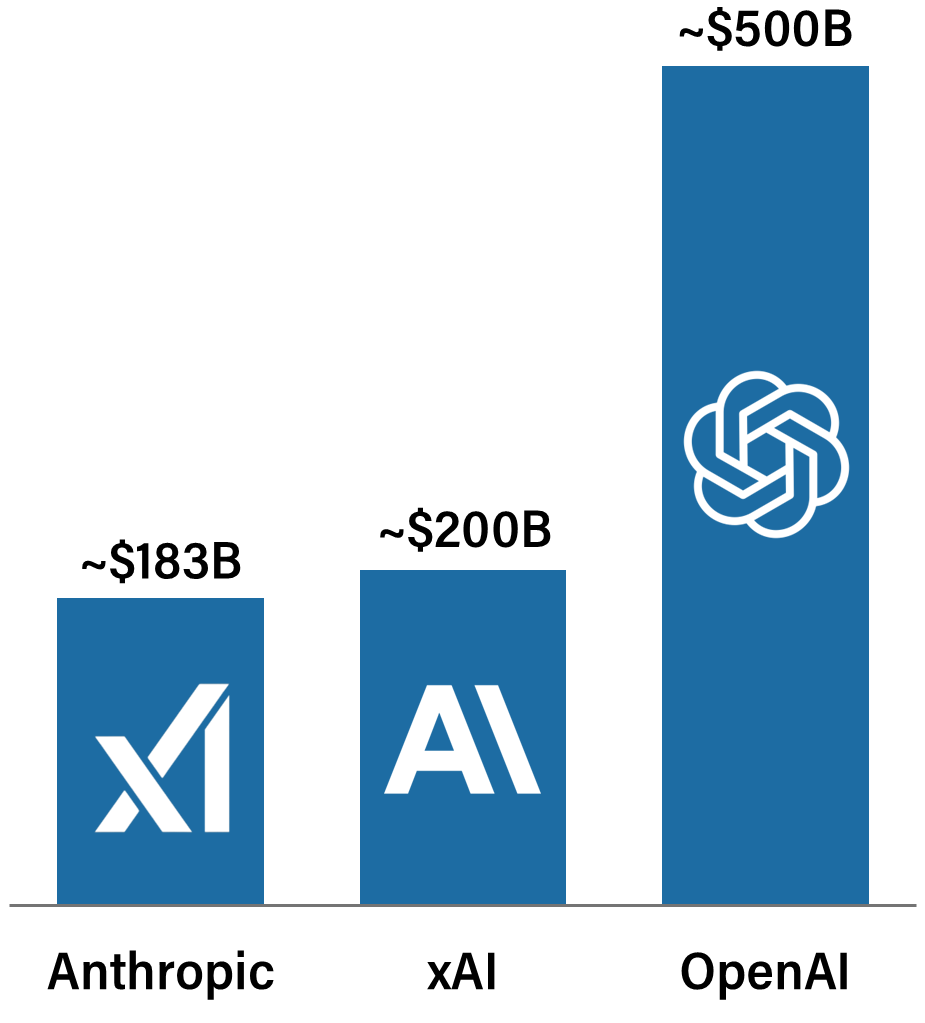
By comparison, Anthropic’s proposed $1.5B settlement is less than 1% of these numbers. For a company like OpenAI, it’s a small part of their current annual revenue, and a minuscule fraction of their projected future annual revenue. That mismatch underlines how small these payouts are relative to the value extracted from creators’ works.
The “Pirate-Now, Pay-Later” Strategy
History shows a pattern: Technology companies like Spotify or YouTube have, in the past, scaled rapidly by using content or IP for free or underpaid to quickly dominate a market, and then try settle lawsuits after they’ve locked in distortionary advantages. AI could now be following the same path.
If training sets are built on freely scraped content without any consequences, creators will be left with few rights and even less leverage. Within a short time, AI firms and their shareholders and investors will have captured trillions of dollars in value built on creators’ work. The earlier deals start to be discussed, and pressure builds up on them to pay their share, the easier it will be to avoid getting trampled on by the move-fast-and-break-things mantra of Silicon Valley.
Giving Creators a Choice
It comes down to consent and control. Creators should decide if their work is included in AI training, and at what price. Maybe some want exposure, others want premium fees. That decision belongs to them.
And this isn’t only about big names. Journalists, academics, coders, even everyday writers — all contribute data. If AI is going to power the next economy, its foundation must respect those contributions.
The Publishers Pushing Back
OpenAI has already struck several major content‐licensing deals with news publishers to access high-quality journalism. The key strategy these publishers have used to receive compensation is suing the AI firms for copyright infringement. The creators of AI LLMs have consistently settled these lawsuits to continue to have access to their content and, perhaps, also to avoid further scrutiny into what data was used to train their models.
One of the largest deals was made with News Corp (owner of The Wall Street Journal) valued at over $250 million over five years, which grants OpenAI access to both current and archived content from News Corp publications. Dotdash Meredith, owner of People magazine and Better Homes & Gardens, reportedly settled for ~$16 million with OpenAI.
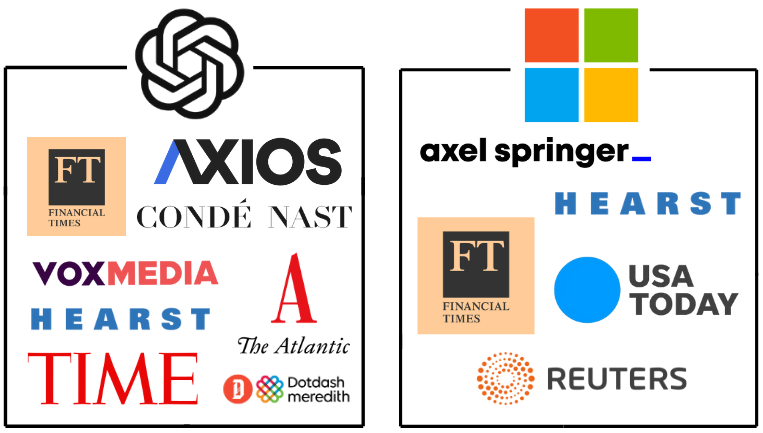
While many contractual terms remain undisclosed — especially in agreements with the New York Times and others — reports suggest OpenAI has offered publishers somewhere between $1 million and $5 million annually for training rights. Such deals show publishers can push back to negotiate compensation rather than accept uncompensated use of their work—and creators should partner with their publishers to demand similar licensing terms and transparency.
While many contractual terms remain undisclosed — especially in agreements with the New York Times and others — reports suggest OpenAI has offered publishers somewhere between $1 million and $5 million annually for training rights. Such deals show publishers can push back to negotiate compensation rather than accept uncompensated use of their work—and creators should partner with their publishers to demand similar licensing terms and transparency.
A Way Forward
- Licensing marketplaces: Publishers, record labels, studios should build systems like ASCAP/BMI but for AI training data — where creators can set differentiated prices for different kinds of users (humans vs. LLMs).
- Transparency: Companies like OpenAI should publish what data they train on and negotiate directly with rights holders. Governments should, at a minimum, require this transparency from developers to help publishers self-enforce their copyrights.
- Precedent matters: Courts approving inadequate settlements risk institutionalizing low pay. Copyright reform at the federal level may be necessary to set a framework that balances respect for creators’ works and encourages technological development.
The Bottom Line
Generative AI has created trillions in value for tech firms and their shareholders. If that value is built on uncompensated labor, we risk repeating the same erasures that hollowed out creative industries in past tech waves. Differentiated pricing isn’t just fair — it’s unavoidable.
Creators are owed more than exposure or legal disclaimers. It’s time for AI firms to pay for the data they depend on — not to hide behind the “publicly-available” argument that may be obscuring their copyright infringement.
At Handal Dunaway, we believe innovation should reward everyone who contributes to progress — not just those who commercialize it. Our research team closely follows the intersection of technology, intellectual property, and global capital markets to help investors anticipate risks and capture opportunities. In our related piece, Artists and Brand Alignment: Turning Sponsorships into Strategy, we explore how artists can turn partnerships into long-term brand equity — a concept that parallels the fight for fair compensation in the age of AI, where creators must think strategically about how their work is used and valued.
Sources
- https://www.adweek.com/media/openai-dotdash-meredith-licensing-payment/
- https://www.anthropic.com/news/anthropic-raises-series-f-at-usd183b-post-money-valuation
- https://www.reuters.com/business/openai-eyes-500-billion-valuation-potential-employee-share-sale-source-says-2025-08-06
- https://www.forbes.com/sites/danielnewman/2025/08/21/the-ai-bubble-paradox-why-openais-500-billion-valuation-proves-the-opposite/
- https://www.anthropic.com/news/anthropic-raises-series-f-at-usd183b-post-money-valuation
- https://www.reuters.com/business/media-telecom/global-news-publisher-axel-springer-partners-with-openai-landmark-deal-2023-12-13/
- https://www.reuters.com/business/musks-xai-seeks-up-200-billion-valuation-next-fundraising-ft-reports-2025-07-11/
- https://www.reuters.com/business/openai-eyes-500-billion-valuation-potential-employee-share-sale-source-says-2025-08-06
- https://www.wsj.com/business/media/openai-news-corp-strike-deal-23f186ba
- https://www.theinformation.com/articles/openai-offers-publishers-as-little-as-1-million-a-year
- https://www.wsj.com/business/media/amazon-to-pay-new-york-times-at-least-20-million-a-year-in-ai-deal