
In this article, we explore why Latin Americans should consider investing in U.S. financial markets alongside Real Estate, as the markets have consistently delivered stronger long-term returns than Latin American Real Estate.
The Hidden Costs of Only Investing in Real Estate
Across Latin America, most individual investors concentrate their capital in real estate and small regional businesses, which are classic, culturally embedded approaches to building wealth. Real estate, in particular, is seen not just as a financial asset but as a legacy tool: a property purchased today is often intended as an inheritance for future generations. But this attachment often masks real financial trade-offs. Investment real estate, while tangible and familiar, carries significant costs that investors frequently underestimate: property taxes, maintenance, insurance, legal compliance, management overhead, and periods of vacancy all quietly erode returns over time. Unlike investing in the stock markets, which requires little active engagement and, mostly, patience, holding property demands active engagement and ongoing capital investments.
This typical concentration of capital in one asset class clashes with the constant economic and political instability of most countries in the region. For Latin American investors who seek not just preservation of capital but to grow their wealth and minimize the booms-and-busts, the data increasingly points to the urgent need of diversification and increasing investment in the US and global financial markets.
U.S. Financial Markets: Resilience, Scale, and Compounding Power
The U.S. equity markets, particularly the S&P 500 and the NASDAQ Composite Indexes have delivered outstanding long-term returns, driven by world-leading innovation, capital efficiency, and investor protections. From 2011 to 2024, $100,000 invested in the NASDAQ would have grown to $748,010 at the end of 2024, while in the S&P 500 it would have reached $469,699. These returns aren’t linear—they’re the result of consistent reinvestment, rapid post-crisis recoveries, and an unmatched capacity of the market to absorb global shocks.
Capital Flexibility: A Hidden Driver of Long-Term Outperformance
U.S. financial markets offer something real estate usually can’t: liquidity. Investors can move their money quickly to buy, sell, or shift between sectors in seconds. This flexibility allows them to respond to market changes, manage risk, and take advantage of new opportunities as they arise.
Real estate, on the other hand, is illiquid. Selling a property at a fair price can take months or even years, and usually involves legal steps, paperwork, and high transaction costs. For many Latin American investors, this lack of flexibility has often meant missing out on promising business opportunities, with capital stuck in hard assets when opportunities arise, typically during local downturns.
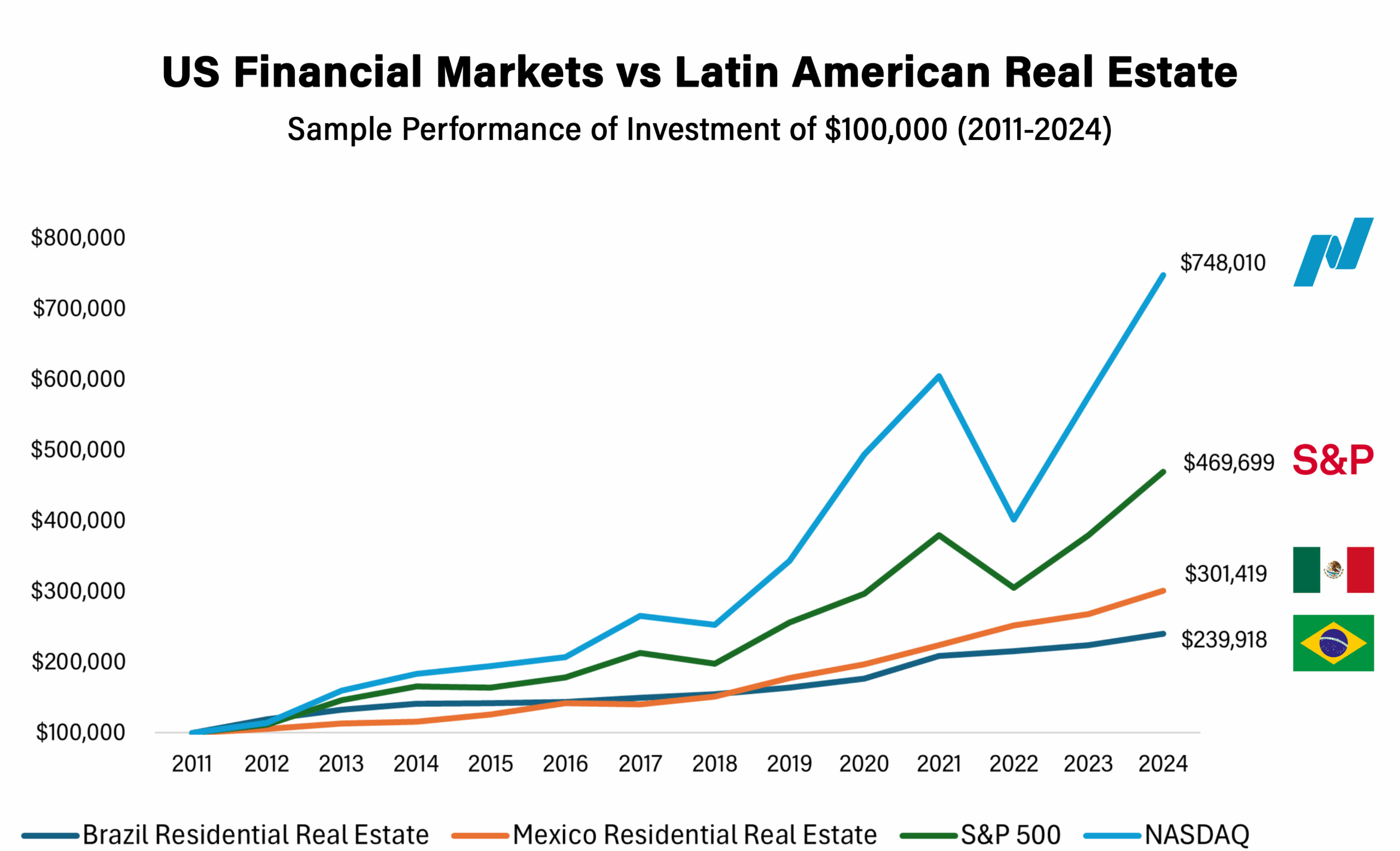
Note: 1. Performance of Mexican and Brazilian real estate markets based on the growth in value of the median residence sold that year, held at a fixed exchange rate to exclude the effects of currency movements.
Latin American Real Estate: Returns That Trail Behind U.S. Markets
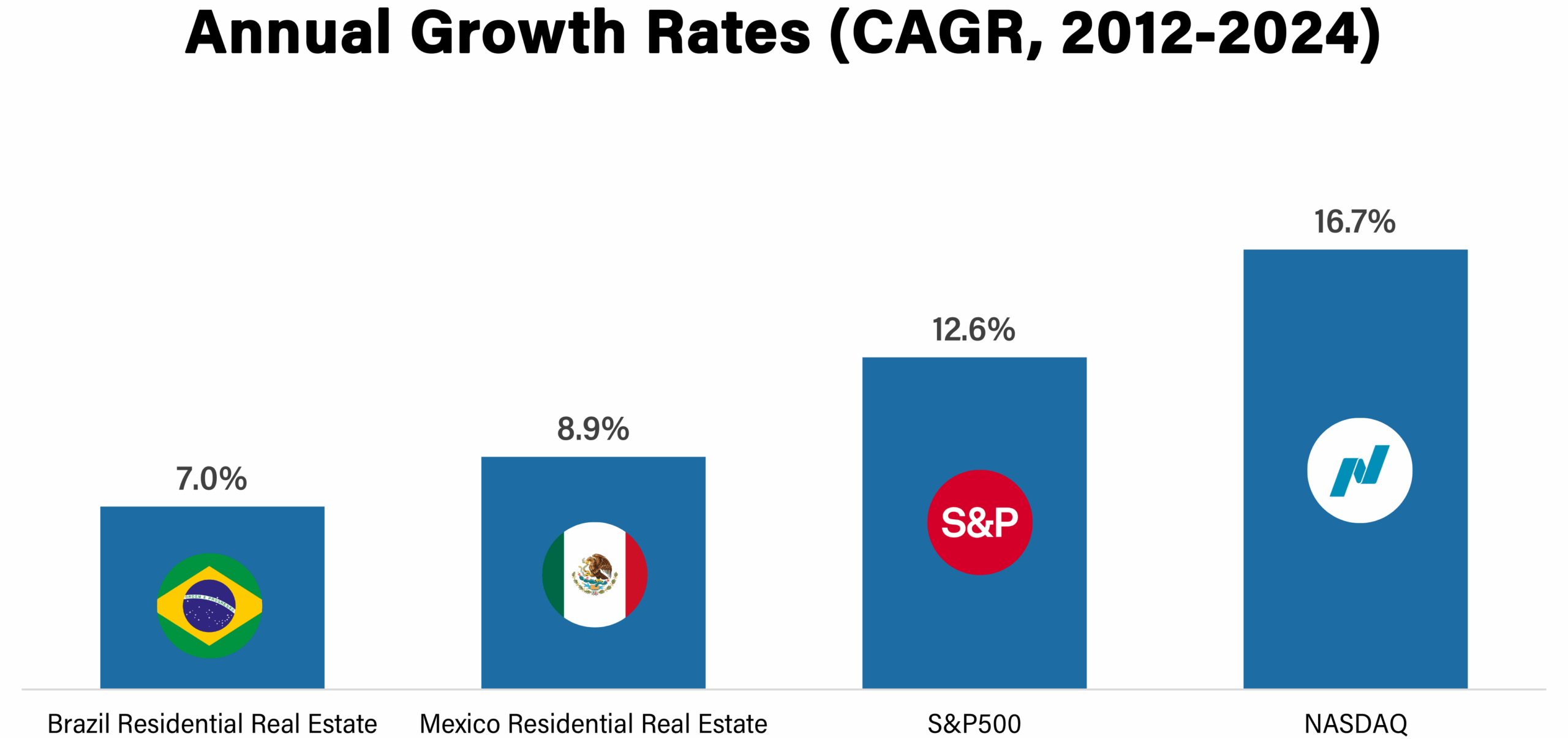
In Mexico, residential property grew at a compound annual rate of 8.9% from 2011 to 2024, turning a $100,000 investment into $301,419. On the surface, this suggests investing in real estate continues to offer value, particularly for those seeking regional, income-producing assets. But when compared to the U.S. financial markets, the difference becomes clear. Over the same period, the S&P 500 would have grown that same investment to $469,699, while the NASDAQ would have delivered $748,010. That is more than 1.5x and nearly 2.5x the return of Mexican real estate, respectively. And this does not account for hidden costs such as ongoing maintenance, property management, or currency devaluation, all of which further eat into real-dollar gains.
Brazil offers an even starker contrast. A $100,000 investment in residential real estate from 2011 to 2024 would have grown to $239,918 at a 7.0% compound annual growth rate. By comparison, the same amount in the S&P 500 would have been roughly 2 times and over 3 times more, respectively. These figures speak for themselves. While Brazilian property prices rose, they lagged far behind the growth of U.S. equities. For investors, that means concentrating solely on domestic real estate means lower returns and fewer opportunities to benefit from global innovation. Investors need to consider whether that trade-off is still worth it today.
The Takeaway: Consider the Financial Markets
Real estate will always have its place in offering a sense of tangibility, control, and safety. But when viewed through the lens of long-term growth, flexibility, and wealth creation, U.S. financial markets offer clearer advantages. Historically higher returns, immediate liquidity, and global exposure make them uniquely suited for investors seeking to grow—not just preserve—their capital.
At Handal Dunaway, we help Latin Americans invest confidently in the US and global financial markets. Our mission is to empower to grow their portfolios, protect their assets from local financial downturns, and unlock the full potential of their wealth. If you’re ready to go beyond borders, we stand ready to help.
Latin American